What is DeepDive?
onowords DeepDive is a specialized reference series built to trace the sensory logic and hidden boundaries of Japanese onomatopoeia.
Moving past simple translations, this series maps nuance and practical usage parameters with quiet, detailed precision—providing an archive of sound-symbolic records for manga creators, translators, and advanced learners.
Developed primarily as a fully realized PDF edition, it serves as a personal field guide for shaping precise emotional and physical presence through sound.
Read more about what DeepDive is
DeepDive is a structured observation series designed to document Japanese sound symbolism through close comparative analysis and real-world usage logs.
The system tracks the exact friction points where native intuition operates: the precise subtext a speaker signals, the tipping points where near-synonyms diverge, and the subtle laws governing what renders a combination natural or unpredictable.
Each volume archives a targeted cluster of mimetic expressions through:
- Boundary-based comparative maps
- Documented spectrums of natural and awkward combinations
- Close, structurally aligned English descriptions
- Spatial, atmospheric, and scene-specific logs
- Tactile, psychological, and sensory observations
DeepDive is built for:
- Manga artists looking to control narrative atmosphere and physical resonance
- Translators requiring an exact, high-resolution understanding of nuance
- Advanced learners studying onomatopoeia as a functional, observation-based system
The series is optimized as a meticulously structured PDF edition, formatted specifically for cross-referencing, quiet annotation, and active production environments.
A Kindle edition is also available for sequential reading, though the PDF remains the primary format for professional use.
DeepDive is neither a standard dictionary nor a beginner’s primer.
It is an internal manual for creators who require a deep, detailed observational grasp of Japanese sound symbolism.
Series1: Threshold Guides
Threshold Guides isolates the structural boundaries between closely related Japanese mimetic words—delineating the precise friction points that native intuition navigates but rarely articulates.
Built as an analytical field guide, it deconstructs each word pair into distinct observation axes, mapping the structural shift through a progression of Before / At / Beyond contextual records.
For creators, translators, and advanced learners who recognize a shared meaning but require a high-resolution map of the underlying divergence, this series provides the exact linguistic criteria to identify and deploy the correct expression.
View all Threshold Guides (PDF)→
Read more about Threshold Guides
Subtitle: A Guide to the Nuance Boundary Between Japanese Mimetic Words
Threshold Guides operates as a close observation system within the onowords DeepDive project—part structural reference, part methodical reading log.
It is compiled specifically for those who understand static dictionary definitions yet encounter the subtle uncertainty of why one expression anchors a sentence naturally while an adjacent word creates a slight, unspoken friction.
What this series does
Each volume isolates a pair of frequently overlapping mimetic expressions, mapping their structural divergence across 3–5 unique observation axes specifically tailored to that word pair. For example, a single log might isolate variables such as:
- Emotional transparency
- Social direction
- Emotional cleanliness vs ambiguity
- Contextual triggers
These variable axes trace the volatile internal logic that standard reference works leave unexamined.
To document the threshold where one expression gives way to the next, each axis is anchored by a Before / At / Beyond structural blueprint:
- Before — the contextual zone where the primary word remains entirely natural
- At — the precise threshold where the structural nuance begins to turn
- Beyond — the adjacent zone where the secondary word claims natural preference
This framework stabilizes abstract sensory nuance into a legible, documented path.
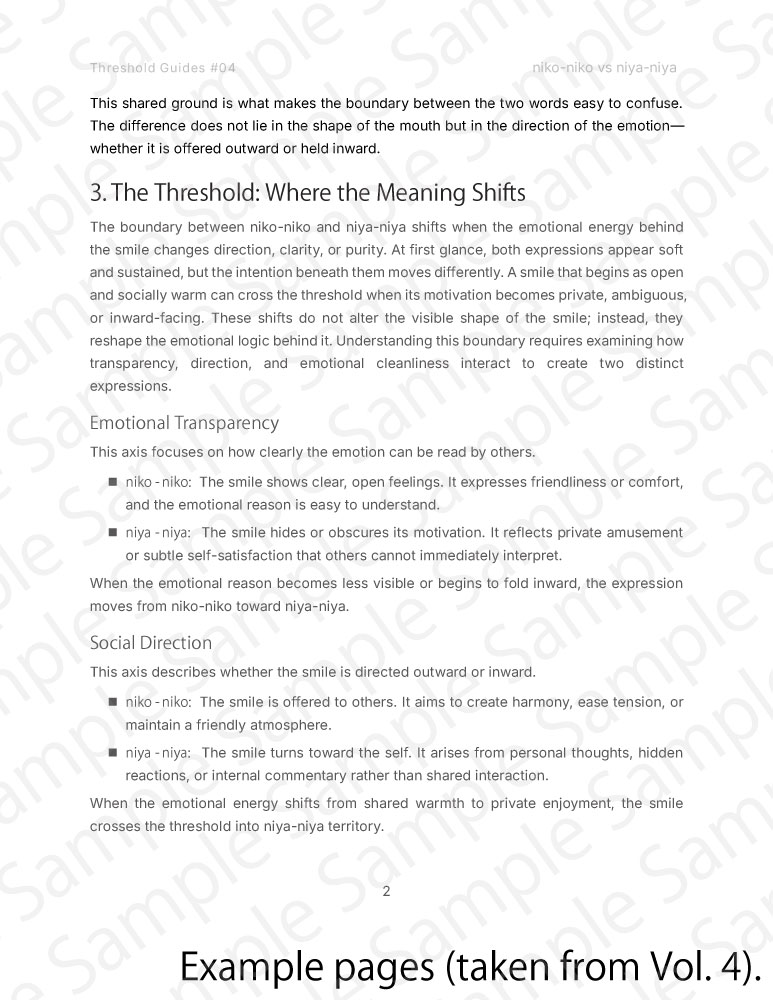
Preview from “niko-niko vs niya-niya” (Threshold Guides #04)
A short sample to show the depth and clarity of the series.
Core Images (excerpt)
niko-niko anchors an open, welcoming expression that projects warmth outward toward an interlocutor—steady, gentle, and socially transparent.
niya-niya turns entirely inward, shaped by private amusement, hidden subtext, or quiet mischief.
The structural divergence lies not in the physical geometry of the smile, but in the vector of direction and the emotional transparency behind the gesture.
One Boundary Axis (excerpt)
Emotional Transparency
niko-niko: clear, legible intent; easily read by an external observer.
niya-niya: private, ambiguous motivation; inward-facing amusement.
As the underlying emotional catalyst becomes obscured from view, the expression moves across the threshold toward niya-niya.
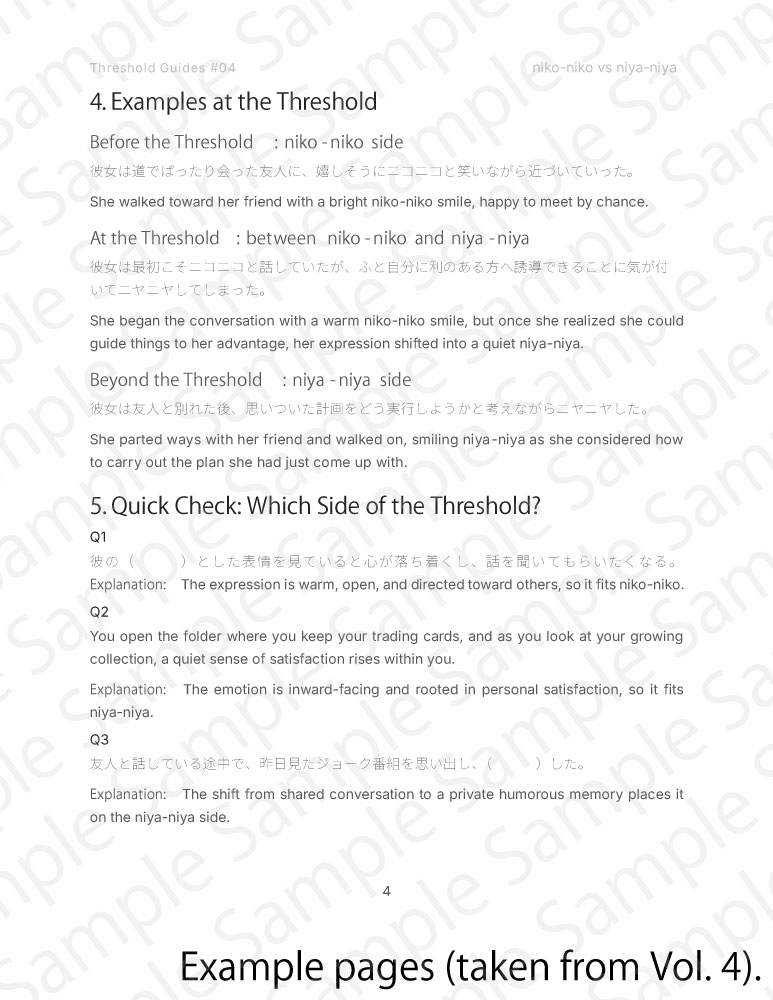
Before / At / Beyond (excerpt)
Before — niko-niko
彼女は道でばったり会った友人に、嬉しそうにニコニコと笑いながら近づいていった。
She walked toward her friend with a bright niko-niko smile, happy to meet by chance.
At — threshold
彼女は最初こそニコニコと話していたが、ふと自分に利のある方へ誘導できることに気が付いてニヤニヤしてしまった。
She began the conversation with a warm niko-niko smile, but once she realized she could guide things to her advantage, her expression shifted into a quiet niya-niya.
Beyond — niya-niya
彼女は友人と別れた後、思いついた計画をどう実行しようかと考えながらニヤニヤした。
After parting ways, she walked on, smiling niya-niya as she considered how to carry out the plan she had just come up with.
Unique strengths of Threshold Guides
- Core Images: Tracking emotional vector, somatic sensation, and internal psychological shifts
- Shared Ground: Locating the exact space where words overlap before mapping how they separate
- Boundary Axes: Deconstructing fluid nuance into clear, observable components
- Before / At / Beyond: Stabilizing the internal threshold into an intuitive visual map
- Noun Cues: Identifying the specific linguistic environments that naturally attract each word
- Creative Applications: Connecting observed nuance directly to narrative prose and translation choice
- One‑page Summary: A compact, consolidated overview for quick structural review
- Comprehension Check: Three short verification exercises to confirm structural mastery
Who this series is for
- Advanced Learners: Seeking to articulate the structural boundaries behind implicit intuition
- Readers: Able to recognize a tone passively but looking to deploy it actively with precision
- Translators: Requiring a reliable metric to verify cross-linguistic equivalence
- Creators: Intending to map subtle psychological shifts and character subtext onto narrative space
- Linguistic Observers: Who view mimetic words as a highly functional, interconnected system
What you will be able to do
Through these structured observation records, you will be able to:
- Explain the divergence between adjacent mimetic expressions in clear, structural terms
- Select the naturally aligned expression in prose, dialogue, or translation
- Isolate and eliminate “approximate but slightly volatile” language choices
- Trace how emotion, physical sensation, and context converge to shape a word’s presence
- Navigate manga and literature with a quiet, heightened sensitivity to character subtext
Threshold Guides moves past individual definitions, mapping the fluid territory of Japanese mimetic nuance into a connected observational map.
Series2: Mimetic Compatibility Guides
Mimetic Compatibility Guides documents the precise affinities between Japanese mimetic words and specific material targets.
Built as a tactile reference for creators and translators, it provides reverse-lookup observation maps to isolate the exact expressions that dictate an object’s texture, kinetic movement, and ambient atmosphere.
Anchored by structured quadrant maps and documented pairs of aligned or contrasting friction, this series functions as a permanent studio reference for shaping physical resonance through Japanese sound symbolism.
View all Mimetic Compatibility Guides (PDF) →
Read more about Mimetic Compatibility Guides
Subtitle: A Creator’s Guide to How Japanese Mimetic Words Pair with Nouns
Mimetic Compatibility Guides shifts the focus from nuance boundaries to material attachment—documenting how specific mimetic words lock into distinct nouns such as fire, hair, fabric, metal, or water.
It operates as a reverse-lookup archive: instead of analyzing the word in isolation, the observation begins with the physical object or atmosphere intended for the scene.
What this series does
Each volume isolates a single noun, deconstructing its expressive dimensions into specific descriptive axes tailored to that material, such as:
- Intensity
- Kinetic movement
- Sensory impact
- Surface texture
- Airflow / Atmosphere
These variables are plotted onto a four-quadrant map, revealing how clusters of mimetic words organize around differing physical and psychological states of the object. This observation map allows creators to:
- Isolate the exact sound-symbolic match for an object’s specific state
- Compare adjacent expressions across a singular material plane
- Trace the underlying friction that renders a combination natural or jarring
- Calibrate the emotional undercurrent of a scene through precise word attachment
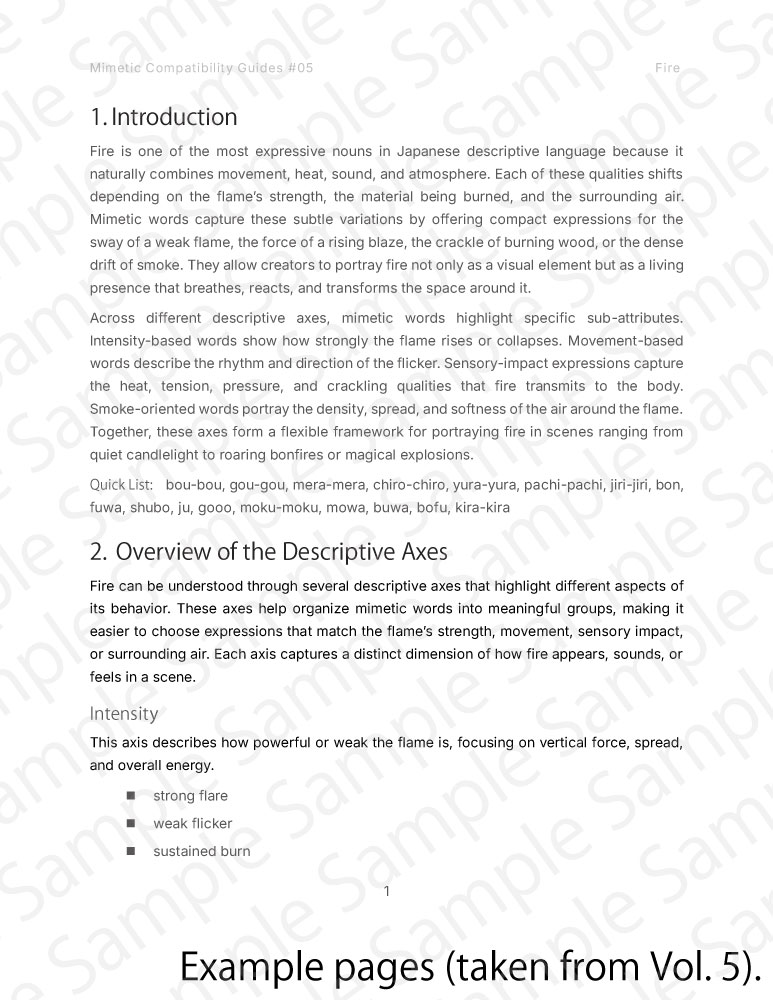
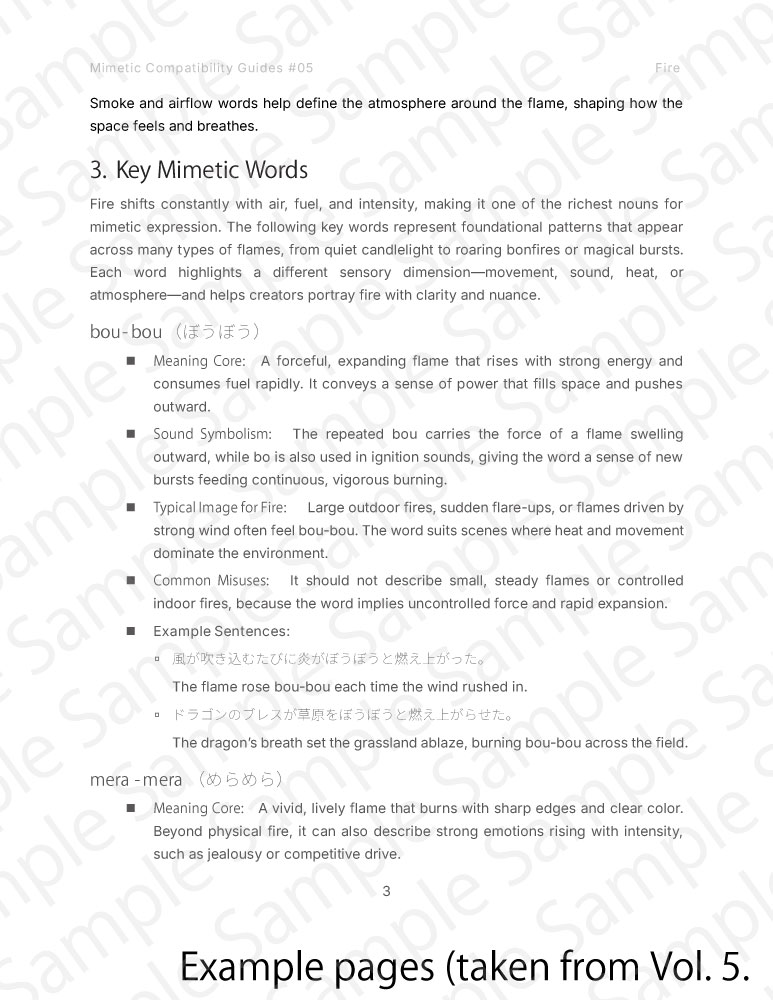
Preview from “Fire” (Mimetic Compatibility Guides #05)
A short sample to show the clarity and creator‑focused structure.
Descriptive Axes (excerpt)
The physical presence of fire is mapped across four expressive dimensions:
- Intensity — forceful flare / fragile flicker / sustained burn / sudden rupture
- Movement — vertical sway / lateral flicker / drifting airborne particles
- Sensory Impact — acoustic heat / sharp popping sparks / scorching thermal tension
- Smoke / Airflow — dense atmospheric drift / soft thermal ascent / swirling currents
Key Mimetic Words (excerpt)
bou-bou(ぼうぼう) — forceful, expanding flames driven by external airflow
mera-mera(めらめら) — vivid, sharp combustion characterized by explicit visual clarity
yura-yura(ゆらゆら) — gentle, passive sway dictated by ambient currents
pachi-pachi(ぱちぱち) — crisp acoustic fracturing of burning organic matter
moku-moku(もくもく) — dense, voluminous smoke filling spatial boundaries
Four‑Quadrant Map (teaser)
Each volume includes a quadrant map organizing targeted mimetic words along two shifting descriptive axes, permitting a clear reverse-lookup based on the object’s current state. Below is a tracking preview with the specific axes obscured:
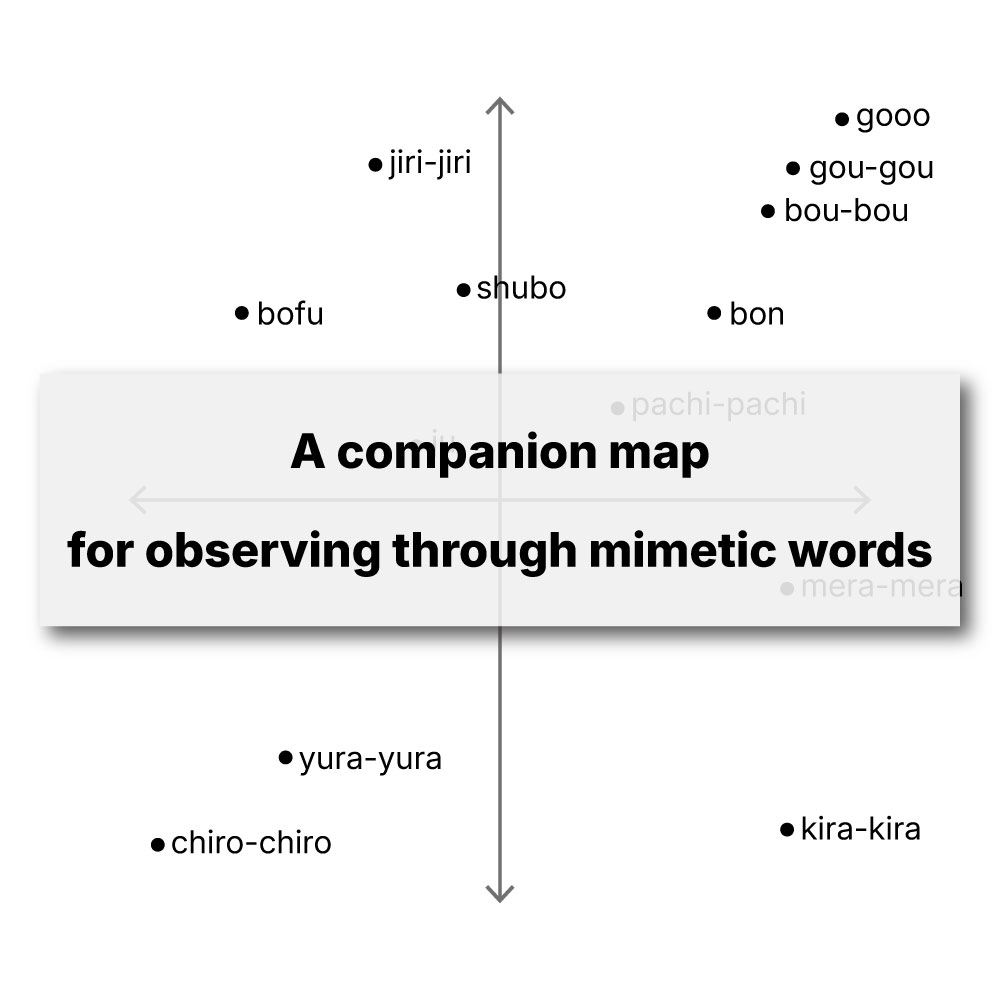
Natural vs Unnatural Pairings (excerpt)
The log identifies combinations aligned with native structural intuition:
- bou-bou → strong, wind‑fed flames
- yura-yura → soft, airflow‑driven sway
- pachi-pachi → crackling wood
- moku-moku → dense smoke
And notes combinations that dilute narrative tension or spatial logic:
- bou-bou applied to candlelight
- yura-yura applied to explosive combustion
- pachi-pachi applied to pressurized gas fire
Unique strengths of Mimetic Compatibility Guides
- Reverse‑lookup quadrant maps: Allowing word selection driven entirely by the object’s physical state
- Material range mapping: Deconstructing each noun into clear, observable descriptive variables
- Documented anomalies: Isolating common missteps that disrupt spatial consistency
- Intentional friction: Mapping deliberate mismatches to introduce symbolic depth or psychological tension
- Multi‑sensory logging: Capturing movement, sound, thermal presence, and spatial atmosphere
- Single-noun field records: Compiling an objective, standalone reference for active production environments
Who this series is for
- Manga artists controlling narrative atmosphere and physical weight
- Translators tracking material texturing across linguistic boundaries
- Illustrators and animators seeking structural grounding for visual movement
- Prose writers requiring exact sensory subtext
- Creators looking to expand beyond generic, repetitive sound choices
What you will be able to do
- Establish an object’s state or environmental tone exclusively through sound symbolism
- Locate expressions via reverse-lookup based on the physical state of the scene
- Deploy deliberate material mismatches to introduce underlying psychological tension
- Broaden the active expressive perimeter for individual physical objects
- Delineate fire, fabric, hair, and atmosphere with absolute tactile clarity
Mimetic Compatibility Guides serves as an enduring field reference, providing a stable observational framework for the active creator’s workspace.
Series3: Scene Detail Guides
Scene Detail Guides documents how Japanese mimetic expressions dictate the atmospheric density, temporal rhythm, and emotional weight of specific narrative settings.
Moving beyond individual words or isolated objects, this series analyzes the entire spatial environment—mapping how sound symbolism governs the surrounding air, thermal presence, internal tension, and structural silence.
Developed as an environmental reference for creators and translators, it isolates the variables required to modulate narrative space between states of slow suspension and heightened pressure.
View all Scene Detail Guides (PDF) →
Read more about Scene Detail Guides
Subtitle: A Guide to How Japanese Expressions Work Across Different Scenes
Scene Detail Guides isolates the behavior of mimetic expressions within a closed narrative setting.
While Threshold Guides tracks nuance boundaries and Mimetic Compatibility Guides maps material attachment, this series documents how sound symbolism scales and shifts inside a singular, integrated space.
What this series does
Each volume dissects a targeted environment into functional expressive components:
- Environmental sound structures
- Kinetic velocity and rhythm
- Thermal levels, pressure, and ambient density
- Objects and tools native to the setting
- Temporal pacing metrics (Slow & Relaxed / Quick & Pressured)
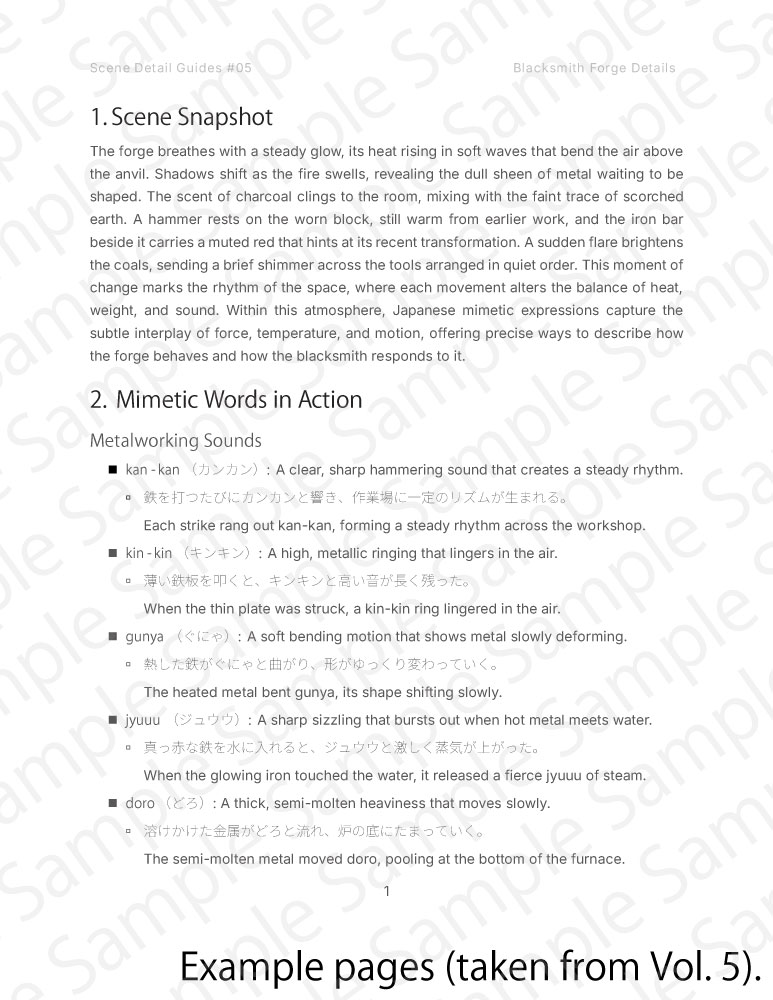
Preview from “Blacksmith Forge Details” (Scene Detail Guides #05)
A short sample to show the scene‑based clarity and atmospheric focus.
Scene Snapshot (excerpt)
The forge operates with a steady thermal glow, heat rising in soft waves that warp the immediate air.
Shadows shift in alignment with the fire’s expansion, tools reflect the ambient light, and the targeted metal rests at a muted red.
This documented atmosphere serves as the matrix for selecting mimetic expressions that govern force, temperature, and motion.
Mimetic Words in Action (excerpt)
Metalworking Sounds
kan-kan — clear, rhythmic fracturing of space via hammering
kin-kin — high-frequency metallic resonance
gunya — low-velocity deformation of heated metal
jyuuu — abrupt, high-pressure steam release
sha-sha — high-friction sharpening movement
Fire & Furnace
gooo — deep, low-frequency roaring combustion
pachi-pachi — crisp acoustic fracturing of embers
pa-pa — rapid, intermittent bursts of sparks
mera-mera — vivid, ascending thermal paths
Blacksmith Movements
fuu — low-velocity exhalation
gachan — firm, weighted material contact
zun — high-mass structural landing
pota — single, high-mass drop of sweat
Scene Dynamics (excerpt)
Slow & Relaxed
Tools remain stationary with a heavy zun or a muted gachan.
Flames rise mera-mera on their own, establishing a flat, steady thermal baseline.
Quick & Pressured
Acoustic impacts accelerate into kan-kan or kin-kin.
Airborne particles rupture pa-pa, and rapid thermal reduction releases a sharp, high-pressure jyuuu.
Unique strengths of Scene Detail Guides
- Atmospheric logging: Capturing air density, thermal levels, spatial pressure, and deliberate silence
- Spatial breathing: Modulating environments through contrasting Slow & Relaxed vs Quick & Pressured temporal logs
- Contextual reference scripts: Example configurations engineered for specific environmental parameters
- Integrated sound layering: Mapping concurrent variables (combustion, tool friction, kinetic movement, respiration)
- Coupled mechanics: Tracking the interaction between physical objects and human movement variables
- Transition logging: Recording shifts in heat progression, luminous intensity, and kinetic velocity
Who this series is for
- Manga creators controlling environmental weight and spatial immersion
- Prose writers requiring exact atmospheric subtext
- Illustrators and animators seeking structural grounding for scene pacing
- Game scenario architects mapping environmental tone
- Translators requiring verified contextual equivalents across shifting narrative registers
What you will be able to do
- Calibrate spatial environments between **Slow & Relaxed** and **Quick & Pressured** states through sound symbolism alone
- Embed precise environmental anchors to stabilize reader immersion
- Diversify narrative texturing using structurally verified reference examples
- Outline atmospheric density, thermal presence, and tension rather than mere physical actions
- Construct narrative settings anchored by consistent spatial logic and emotional velocity
Series4: Mimetic Example Guides
Mimetic Example Guides operates as a precision reference manual analyzing how Japanese mimetic words integrate, or fail to integrate, within live sentence structures.
Built for translators, advanced learners, and creators working closely with narrative language, it maps the precise transition between native fluidity, outright misapplications, and the highly elusive gray zone—sentences that satisfy formal grammatical rules yet induce a subtle friction in native intuition.
By tracking these granular shifts through graded contextual observation, this series exposes the hidden boundaries of contextual nuance left unrecorded by traditional dictionaries.
View all Mimetic Example Guides (PDF) →
Read more about Mimetic Example Guides
Subtitle: A Guide to Natural and Unnatural Japanese Usage
Mimetic Example Guides traces the live behavioral mechanics of Japanese mimetic words inside active sentences.
While adjacent series isolate conceptual boundaries or physical target attachment, this volume documents nuance through graded operational tracking—ranging from intuitive alignment to borderline contextual friction and clear structural failure.
Each volume isolates a distinct thematic domain, subjecting 15 selected words to 10 distinct contextual environments per entry.
By cross-examining optimal usage with context-restricted applications and structural misfires, the series decodes the deep logic governing internal rhythm, cognitive imagery, and native linguistic perception.
What this series does
Every targeted entry is systematically deconstructed across a standardized contextual grid:
- Collocation Matrix — recurrent word pairings that anchor baseline fluency
- Aligned Usage — sentences that achieve seamless, intuitive integration
- Context-Dependent Friction — configurations that function only under hyper-specific parameters
- Structural Misfires — clear boundary failures that violate the word’s internal logic
- Core Spatial Image & Common Pitfalls — the underlying sensory logic driving the expression
This tracking framework permits creators and translators to:
- Pinpoint the exact variables causing a sentence to feel perceptually misaligned
- Differentiate between fluid integration, borderline anomaly, and total contextual failure
- Observe how sound-symbolic value mutates across shifting prose rhythms, tones, and context
- Preemptively eliminate subtle friction points that disrupt reader immersion
- Synchronize their creative output with native spatial and sensory intuition
The Observation Loop (Human & AI Collaboration)
The reference tracking in this series is developed through a paired process of human linguistic analysis and structured AI-assisted sentence generation.
AI is utilized strictly as a high-volume tool for producing raw candidate sentences, while the theoretical framework and final validation remain entirely human-driven.
- The generation tool is prompted to produce 50 “natural” example sentences for a targeted mimetic word.
- Flawlessly integrated sentences are extracted to serve as reference anchors.
- Statistically, approximately 30% of the raw output occupies a distinct gray zone—grammatically correct, yet carrying a faint, systemic dissonance.
- From this critical tier, sentences engineered to expose typical non-native blind spots are isolated as “context-dependent friction” benchmarks.
- This tracking loop demonstrates that even highly sophisticated modern AI routinely validates configurations that native intuition identifies as uncanny.
- These borderline strings are neither grammatically flawed nor fully invalid; rather, their underlying sensory subtext is subtly out of phase.
- Isolating and decoding these micro-mismatches is precisely what calibrates a creator’s perception of real Japanese usage.
This validation process documents the exact linguistic terrain that conventional dictionaries and textbooks fail to map, keeping the analytical foundation firmly human-crafted.
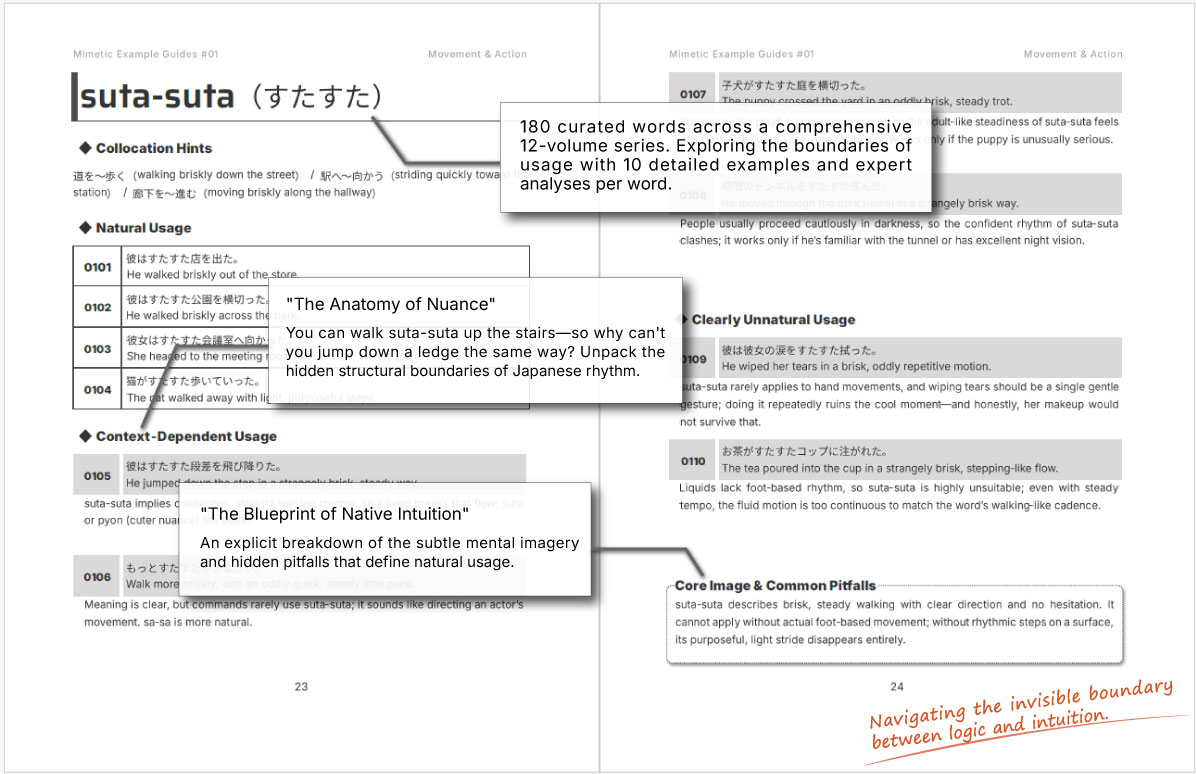
Preview from “Movement & Action” (Mimetic Example Guides #01)
A short excerpt showing how graded usage reveals nuance.
suta‑suta(すたすた) — Excerpt
Aligned Usage
0101 彼はすたすた店を出た。
He walked briskly out of the store.
0103 彼女はすたすた会議室へ向かった。
She headed to the meeting room with a brisk, steady pace.
Context‑Dependent Friction
0105 彼はすたすた段差を飛び降りた。
He jumped down the step in a strangely brisk, steady way.
Explanation: suta-suta requires a continuous, linear locomotive cadence; a vertical drop ruptures this horizontal trajectory. A singular kinetic burst like suta or the lighter pyon would resolve the structural friction.
0106 もっとすたすた歩きなさい。
Walk more briskly, with an oddly quick, steady little pace.
Explanation: While the informational intent is clear, imperative commands rarely tolerate suta-suta; it yields an uncanny effect, as if mechanically directing a stage performer’s physical pacing. The fluid urgency of sa-sa is naturally required here.
Structural Misfires
0110 お茶がすたすたコップに注がれた。
The tea poured into the cup in a strangely brisk, stepping-like flow.
Explanation: Liquids lack independent bipedal mechanics. Because suta-suta is explicitly bound to foot-based rhythmic progression, it cannot map onto continuous fluid motion, rendering the sentence structurally incoherent despite its steady velocity.
Core Spatial Image & Common Pitfalls
suta-suta dictates a brisk, uninterrupted bipedal stride toward a definitive destination, free from cognitive hesitation.
It cannot be detached from actual foot-to-surface mechanics; without the alternating impact of strides on a physical plane, its inherent purposeful velocity completely destabilizes.
Unique strengths of Mimetic Example Guides
- Graded Contextual Mapping: Tracing expressions across the full continuum of linguistic viability
- Boundary Diagnostics: Explicitly demarcating the structural limits of word integration
- Gray-Zone Documentation: Isolating the “micro-unnatural” tier left unaddressed by traditional pedagogy
- Comprehensive Database: Tracking 180 core words across 12 hyper-focused thematic logs
- Production-Ready Syntax: A functional diagnostic manual for advanced users manipulating live prose
Who this series is for
- Intermediate-to-advanced practitioners seeking native-level syntactical command
- Translators isolating micro-frictions across high-fidelity source texts
- Manga and anime architects verifying dialogue and textual consistency
- Narrative designers and editors requiring uncompromised prose precision
- Anyone looking to transcend generic dictionary definitions in favor of live contextual behavior
What you will be able to do
- Classify live sentences into aligned, borderline, or structurally failed tiers with absolute clarity
- Reverse-engineer the sensory logic driving complex sound-symbolic behaviors
- Neutralize micro-errors that fracture narrative realism or break immersion
- Calibrate lexical selection to synchronize perfectly with narrative cadence, velocity, and context
- Construct textual environments that feel completely native to native readers
Volumes & Tracked Words
The complete 12-volume tracking log maps 180 core mimetic expressions across hyper-focused thematic domains:
yoro-yoro, mota-mota, noro-noro, uro-uro, koso-koso, soso-kusa, seka-seka, ata-futa, dota-dota, bata-bata, suta-suta, teku-teku, choko-choko, pyon-pyon, kibi-kibi
niko-niko, iki-iki, haki-haki, teki-paki, hera-hera, niya-niya, bonya-ri, nonbi-ri, dara-dara, guzu-guzu, uji-uji, moji-moji, odo-odo, biku-biku, kyoro-kyoro
hiso-hiso, boso-boso, butsu-butsu, gonyo-gonyo, mogo-mogo, meso-meso, kusu-kusu, pecha-kucha, pera-pera, kya-kya, wai-wai, gyaa-gyaa, gami-gami, gera-gera, wan-wan
su-su, hiri-hiri, chiku-chiku, zuki-zuki, kiri-kiri, gan-gan, jin-jin, iga-iga, muzu-muzu, muka-muka, kura-kura, fura-fura, heto-heto, gu-ttari, zoku-zoku
shin-miri, hono-bono, uki-uki, waku-waku, u-ttori, ho-tto, doki-doki, sowa-sowa, moya-moya, hara-hara, hiya-hiya, ira-ira, musha-kusha, kuyo-kuyo, shon-bori
fuwa-fuwa, funya-funya, shi-ttori, sube-sube, tsuru-tsuru, puni-puni, sara-sara, pasa-pasa, kasa-kasa, zara-zara, beta-beta, nuru-nuru, gowa-gowa, gotsu-gotsu, kachi-kachi
a-ssari, shaki-shaki, saku-saku, kari-kari, kori-kori, hoku-hoku, mochi-mochi, puri-puri, toro-toro, neba-neba, mogu-mogu, paku-paku, gatsu-gatsu, juu-juu, ko-tteri
u-kkiri, pika-pika, kara-ppo, gara-n, deko-boko, bosa-bosa, shiwa-shiwa, yore-yore, pechan-ko, boro-boro, doro-doro, bisho-bisho, gucha-gucha, gocha-gocha, kuta-kuta
suka-suka, potsu-potsu, zura-ri, do-ssari, ta-ppuri, nami-nami, kon-mori, pan-pan, gi-sshiri, bi-sshiri, mi-cchiri, gyuu-gyuu, gichi-gichi, wan-saka, giri-giri
soyo-soyo, shito-shito, jime-jime, mushi-mushi, don-yori, chira-chira, kira-kira, gira-gira, hoka-hoka, poka-poka, muwa-tto, zaa-zaa, byuu-byuu, goro-goro, kara-tto
shiin, pota-pota, kon-kon, kata-kata, pachi-pachi, kan-kan, don-don, goto-goto, gacha-n, zawa-zawa, gaya-gaya, chirin-chirin, bu-n, gou-gou, wan-wan
hira-hira, yura-yura, gura-gura, puka-puka, koro-koro, suru-suru, zuru-zuru, guru-guru, kuru-kuru, gata-n, goto-n, gara-gara, dosa, pita-ri, byun